
Ask most people who is winning AI and you get the same answer. OpenAI. Anthropic. Google. The trillion-dollar labs and their flagship models at five dollars a million tokens. That is the conversation. It is not the usage.
The board
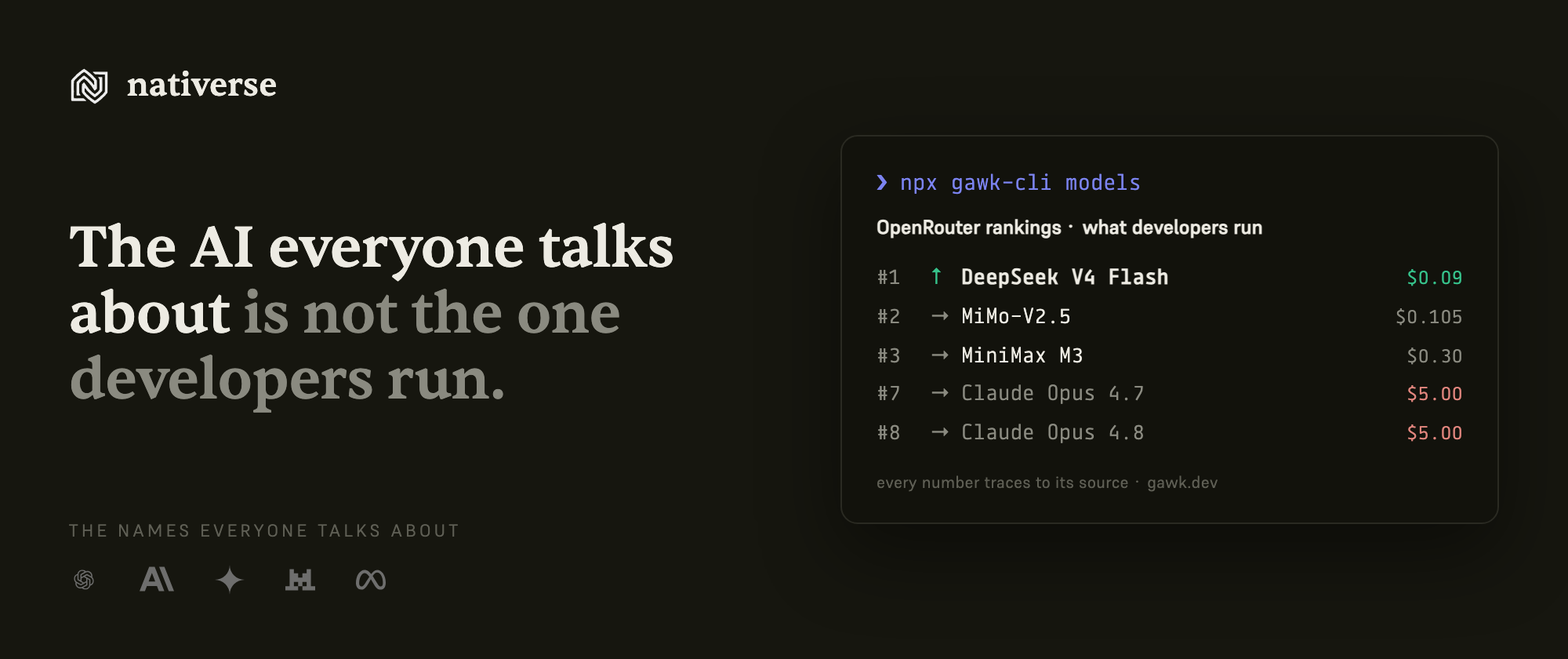
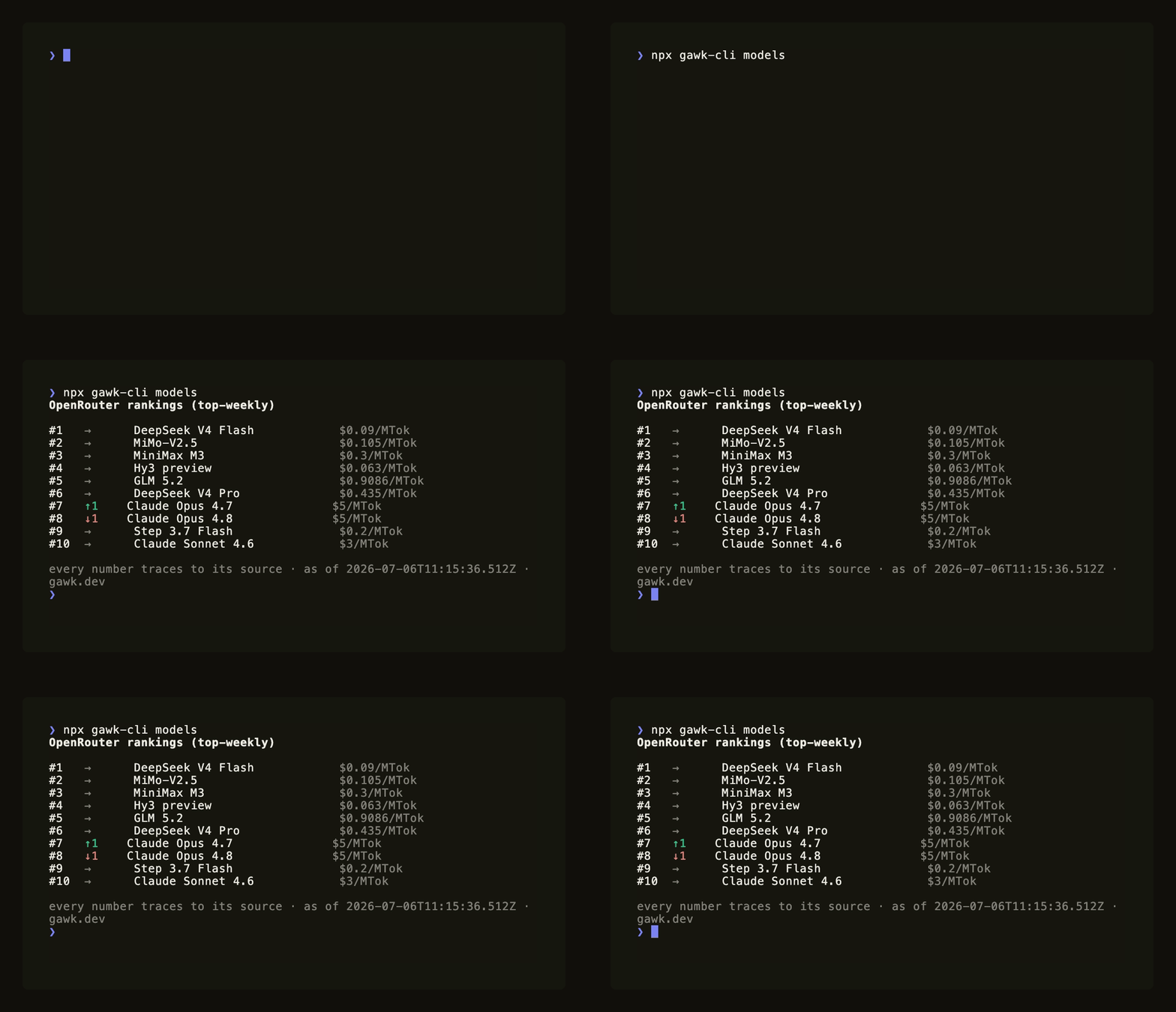
OpenRouter publishes a live ranking of the models developers actually send traffic to, ordered by real use. As I write this, the number one model is DeepSeek V4 Flash, at nine cents per million tokens. The whole top of the board is cheap models, most of them open-weight. The celebrated American flagships, Claude Opus among them, sit at seventh and eighth, at five dollars. More than fifty times the price of the model outranking them.
Here is the board itself, printed live by a command you can run in the next thirty seconds:
You remember the DeepSeek moment. In early 2025 a cheap open model wiped a trillion dollars off Nvidia in a single day and the story became "China caught up". The headlines moved on within a fortnight. The board did not. On the surface where developers pick models for real work, the cheap open models never gave the lead back.
One caveat, up front, because it matters
This is OpenRouter's traffic. OpenRouter is where developers route across many providers to optimise price and performance, so it over-represents the cost-conscious and the open. Teams that call the OpenAI or Anthropic APIs directly are not counted here. So this is not "nobody uses Claude". Plenty do, for good reasons. The honest claim is narrower and more interesting: on the one public board where developers vote with real spend on price and performance, the vote is not going where the headlines point.
I lead with that caveat on purpose. It is the first thing a sharp reader would raise, and a number is only worth showing if you are honest about what it does and does not measure.
Why the gap costs you
If you are choosing what to build on, the distance between the conversation and the usage is exactly the thing that bites. The conversation is optimised for launches and benchmark charts. The usage is optimised for your bill and your latency. Those are different objectives, and only one of them shows up in a keynote. A team that standardised on a five-dollar flagship because it was the name in the room, when a nine-cent model would have carried most of the load, is paying a tax on the discourse.
And this is the shape of almost every number in AI right now. A benchmark a lab chose to report. A ranking with no method attached. A "fastest model" with nothing to compare it to. A status badge that is a claim, not a measurement, which is its own quiet failure. You cannot navigate an ecosystem on numbers you cannot trace.
Insight you can check, in the terminal
That is why we built gawk. It reads the public signals of the AI world and gives you the live pulse, with one rule above the rest: cited, not invented. Which models are actually used, which developer SDKs are rising and falling, which tools are healthy right now, what shipped today. Every figure links to the source it came from. And it is in the place you already work.
npx gawk-cli modelsEvery card prints its source, its age, and a URL. It derives nothing beyond arithmetic on numbers it also shows you. The board above is not a screenshot from a design tool. It is live, and the command that prints it is the one already in your terminal.
Be clear about the limit. gawk will not tell you which model is best for your problem. That is your judgment, on your workload, and no leaderboard can make it for you. What it will tell you, with a source attached to every figure, is what the ecosystem is actually doing, so your judgment starts from facts instead of from a feed.
The board is public. The numbers trace. Do not take the conversation's word for it, and do not take mine. Run it.
npx gawk-cli